

Double Jaw Surgery (Orthognathic Surgery)
Surgical correction of upper and lower jaw discrepancies — functional and aesthetic facial harmony through orthodontics and maxillofacial surgery.
Treatment Time
Personalized, incl. orthodontics
Sessions
Surgery + orthodontic process
Anesthesia
General anesthesia
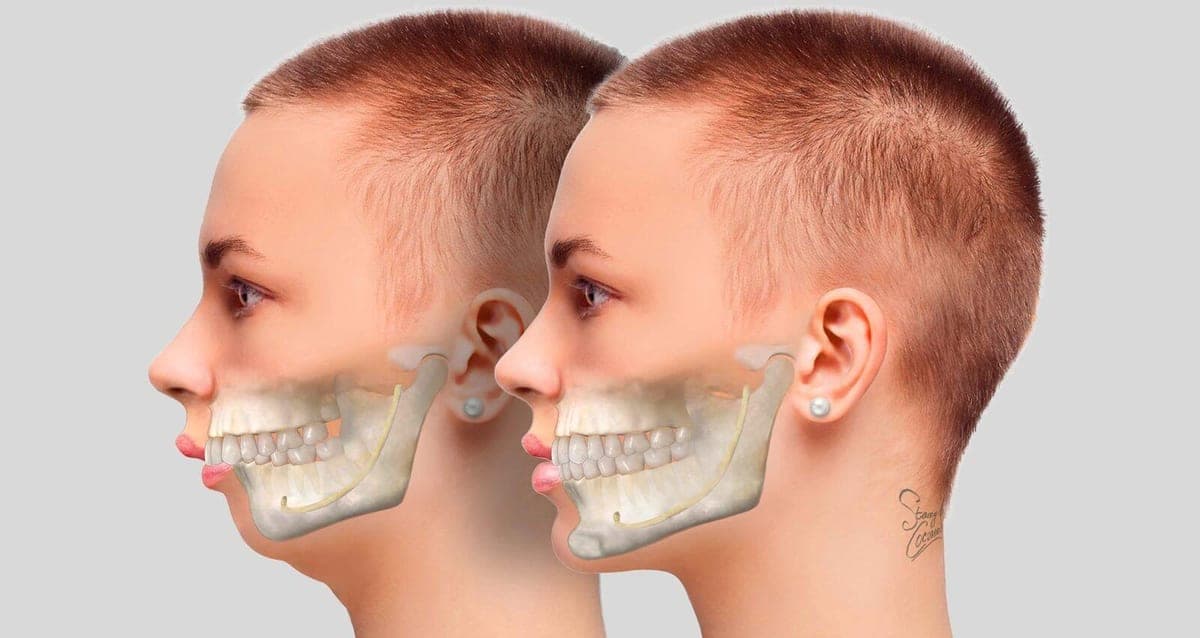
Orthognathic surgery (double jaw surgery) is an advanced treatment that surgically corrects position and size discrepancies between the upper and lower jaws. It is used for skeletal problems that cannot be solved by orthodontics (braces) alone — such as a receded or protruded lower jaw, open bite, crossbite and facial asymmetry.
The goal is to align not only the teeth but also the jaws and facial features with one another, improving both chewing-speech function and facial aesthetics.
Who is double jaw surgery for?
It is considered for patients who have completed jaw growth and have a skeletal bite discrepancy, marked jaw recession or protrusion, open bite, facial asymmetry and related chewing/speech difficulty. Suitability is determined after clinical examination, cephalometric imaging and digital planning with 3D tomography (CBCT).
Orthodontics and surgery working together
Double jaw surgery is planned jointly by orthodontics and maxillofacial surgery: the teeth are first aligned with braces, the jaws are then repositioned surgically, and finally orthodontic fine-tuning is completed. Because both disciplines are under one roof at our center, planning and treatment are carried out in a single location.
Orthognathic surgery in Izmir: why Ege Estetik?
At our Class-A center in Çiğli, Izmir, orthognathic surgery is planned jointly by our associate-professor oral and maxillofacial surgeon and our orthodontist. The operation is performed under general anesthesia in our fully equipped operating theatre with our anesthesiologist; patients are monitored in our observation rooms afterwards.
Content on this site is for informational purposes only and does not replace diagnosis or consultation.
FAQ
Frequently Asked Questions
Braces only move teeth; they cannot change the position of the jaws. If there is a skeletal discrepancy (jaw recession/protrusion, open bite), a lasting result requires surgical repositioning of the jaws. Orthognathic surgery achieves this together with orthodontics.